WITHIN WHAT’S MOST FAMILIAR, A STRANGENESS REVEALS ITSELF
A conversation inspired by Hans Bryssinck’s film Celestino (2025)
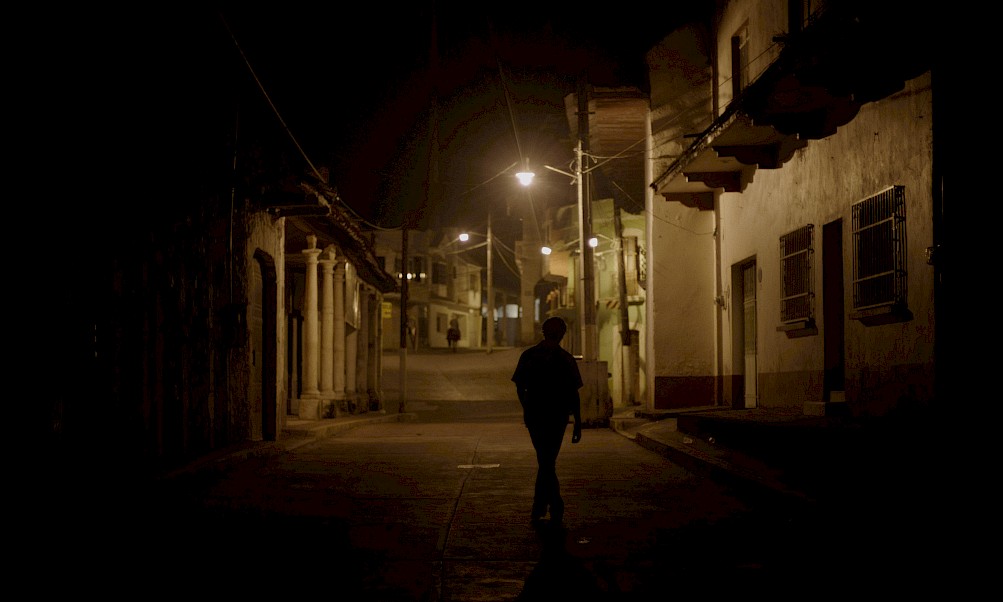
Esteban Lloret Linares: Celestino is your first feature film, but also your first fiction film. What was your inspiration for this project?
Hans Bryssinck: In the late 1990s—1998 to be precise—while I was living in Colombia, the idea of writing a novel came to me. I was 21 years old and felt I had to put my experiences down on paper. The experiences I felt, saw, and heard in these places had a powerful impact that went beyond reality, even though they were real. In 2014, I reconnected with that initial idea, but instead of writing a novel, I decided to make a film. I drew inspiration from my own life experiences for the film’s screenplay. But as I wrote the script, little by little, it became more fictionalized. That’s why I think of the main character as a collection of versions from different moments in my life.
E.L.L.: When you decided you wanted to write a screenplay, what was it like to learn or discover what it means to tell a story in a cinematic way?
H.B.: I had never used dramatic storytelling in my theater and performance work before, so it was something very new. And that's when I discovered the power of storytelling and the omnipresence of narratives, for better or for worse. All the things that happen in terms of narration in our lives are truly remarkable. From there began a process of tension, of negotiation and of learning how to write a good story. But who decides what a good story consists of?
I decided to take the path where, instead of answering the questions the story poses, a new question arises, one that makes the previous question seem less important. And I wanted to maintain this mechanism until the end. According to Alexander Mackendrick, ambiguity is when you set up two very specific situations and both are valid at the same time. That definition helped me understand the difference between ambiguity and confusion, because I didn’t want the viewer to feel confused. On the other hand, there’s something I learned from the concept of nahualism, and that was precisely that there was no need to explain whether something was one way or another. When a being or a person is nahualized, they can have one form or body and at the same time be another. Ambiguity and nahualism are concepts that, for me, are interconnected and they played an important role in the making of the film.
E.L.L.: It seems you had to both learn and unlearn how to tell a story cinematically. Writing and reading are also central to Celestino. Did any literary figures inspire your creative process in general?
There is a book by a Spanish writer, Miguel Unamuno, called San Miguel Bueno, Mártir (1931). There was a quote from this book that inspired me greatly for the entire film: “And I don’t know what is true and what is a lie, nor what I saw and what I only dreamed—or rather, what I dreamed and what I only saw—nor what I knew nor what I believed… Do I know anything? Do I believe anything? Has what I am writing about here really happened, and did it happen like I am telling it? Can things like these really happen? Is this just a dream, within another dream?”
Another important book that has been a constant companion for me is *Pedro Páramo* (1955) by the Mexican writer Juan Rulfo. One thing that inspired me about this book is the way it describes sound—what he hears, the voices he hears from people he cannot see.
E.L.L.: Another new aspect of your work was directing actors for film, which is also a major part of the art of filmmaking. Was that a challenge for you?
H.B.: Directing actors and actresses is a very mysterious thing. I felt that directing was like tightening a nut. It was more a matter of finding subtleties in certain reactions. I wasn’t looking for a realistic performance. Above all, inside the house, we weren’t looking for realism, because the universe inside the house was a parallel world. I was looking for a tone that was a little twisted, a little strange, but at the same time believable and plausible.
I had to give the actors something so they could imagine why they were reacting in a certain way. For example, there are many aspects of the way Jonathan Capdevielle and I worked that had to do with certain mysteries and secrets of Ivan’s character, which aren’t even mentioned in the film. I think you do sense something that makes you say, ‘something is going on with this guy.’
E.L.L.: Yes, you get the sense that he has moments of utter astonishment. However, there are things that aren’t said but can be sensed, things that raise questions. For example, I felt that the sexuality of the characters Ivan and Celestino serve as an underlying theme.
H.B.: I think I drew inspiration there from my own experiences when I was 20 and arrived in Latin America for the first time. At that time, I wasn’t openly gay, and here homosexuality was experienced in a specific way, and I lived my sexuality in this way. When Juan Gabriel was asked in a televised interview, “Is Juan Gabriel gay?”, his response was, “What you can see, you don’t ask about.” And that gives us a clue to understanding how sexual diversity is handled in certain contexts in Mexico, even today. Perhaps it is acknowledged, but it isn’t named.
E.L.L.: I feel that, as a queer person, and from a European perspective, it is sometimes difficult to think about spirituality, because religion is the primary representation of spirituality that we have, and obviously it is a repressive institution for many people. It has robbed us of life’s possibilities, but also of spiritual possibilities. How can one pursue a spiritual quest without repression, without it contradicting one’s own existence?
In Celestino, Iván’s journey is more of a spiritual quest than a religious one. However, the film concludes within a very Catholic context. Given that Catholicism is so important in Latin America, has your relationship to Catholicism been different?
H.B.: My partner, Manuel Guerrero García, is an anthropologist of religion. He recently explained to me that the Virgin of Guadalupe could also be understood by indigenous peoples as a form of resistance, stemming from the goddess Tonantzin, a Nahuatl term meaning “our little mother.” So, we have to understand Catholicism in Latin America from a different perspective, because within Catholicism there are elements that come from other beliefs.
E.L.L.: Catholicism first manifests itself through Celestino’s family. There’s a quote from Kafka that I really like, where he says he stands close to his loved ones—that is, his family—with a knife, ready to attack them, but also to protect them. It highlights that ambiguity in the relationship with the family. How did you approach this theme, this concept?
H.B.: It all stems from a basic idea connected to the way Jean-Luc Nancy approaches the figure of the intruder in his essay of the same name. The quote that inspired me is “within what’s most familiar, a strangeness reveals itself.” It makes me think about how one can experience strangeness within one’s own family, and conversely, how a new place can feel familiar. In the relationship between Ivan and the family, there’s always that ambiguity. None of those women treat him with a clarity that points in just one direction. The character of Alma, for example, treats Ivan neither as family nor as a stranger. For her, it’s the most normal thing in the world for a stranger to show up and come into the house—no questions asked.
E.L.L.: Still, when the sisters see him at the door for the first time, it’s almost as if he were bothering them. They invite him in, but he’s not really that welcome, is he?
H.B.: We have to question the very nature of hospitality. Is unconditional hospitality even possible? We always do things for a reason, even subconsciously. I’m not thinking of selfishness. I mean that they also need to find meaning in this man’s arrival. These are situations I’ve personally experienced at various points in my life. You arrive at a place and are welcomed into a home, into a family. And then they start making decisions for you, and you realize you have to follow a certain dynamic. Maybe they haven’t consulted you, or maybe you don’t like it that much, but they’ve also opened their home to you. So, you’re accepting things that, in your own home, you might not normally do.
E.L.L.: It seems to me that Celestino is a film that talks about many things, and that it doesn’t prioritize one theme over another. But for me, the central theme would be ambiguity. It’s not a movie about being gay in Mexico, it’s not a movie about family, or about spirituality or nahualism, but how everything is intertwined. And that gives the film a sense of unity. However, it’s a matter of perspective.
H.B.: I like working in this way —bringing together two or three themes without establishing a hierarchy among them. I think it’s also an artistic choice. And it’s an invitation to the audience, to the viewer: “I’m giving you this and this and this, and I invite you to connect with what’s most important to you, and I invite you to interpret it.” But there’s a fine line between something that’s open and something that’s scattered. I’m not interested in something that’s scattered, but I am interested in offering options so that there can be multiple interpretations at the same time.
-
Hans Bryssinck is an artist, teacher and narrative practitioner, with a career spanning the visual, performing and audiovisual arts, focusing primarily on collaborative projects. His work includes the film Wilson y Los Más Elegantes(2014). He is co-founder and artistic director of SPIN, a platform for artistic support based in Brussels. He also teaches Performance at the School of Arts in Ghent and Narrative Practices for Community Work and Education at UCIRED in Puebla, Mexico. He has been living in Mexico since 2016, where he wrote the screenplay for Celestino and directed the film.
Esteban Lloret Linares is a French author and film editor. He studied literature and film in France, Belgium, and Argentina. In his writing, he likes to explore topics such as intimacy, individual and collective memory, and queer representation. He lives and works in Brussels, participating in various audiovisual projects with a particular interest in documentaries and transdisciplinary perspectives.